Meeting/Event Information
October 2022 meeting
October 14, 2022
3:15 PM - 8:45 PM
Add to Calendar
Hilton Garden Inn (Evanston)
1818 Maple Avenue
Evanston, IL 60201
Directions
Registration closes at 6 PM Thursday, October 6!
Basolo Medal Award Ceremony and Dinner
Speakers
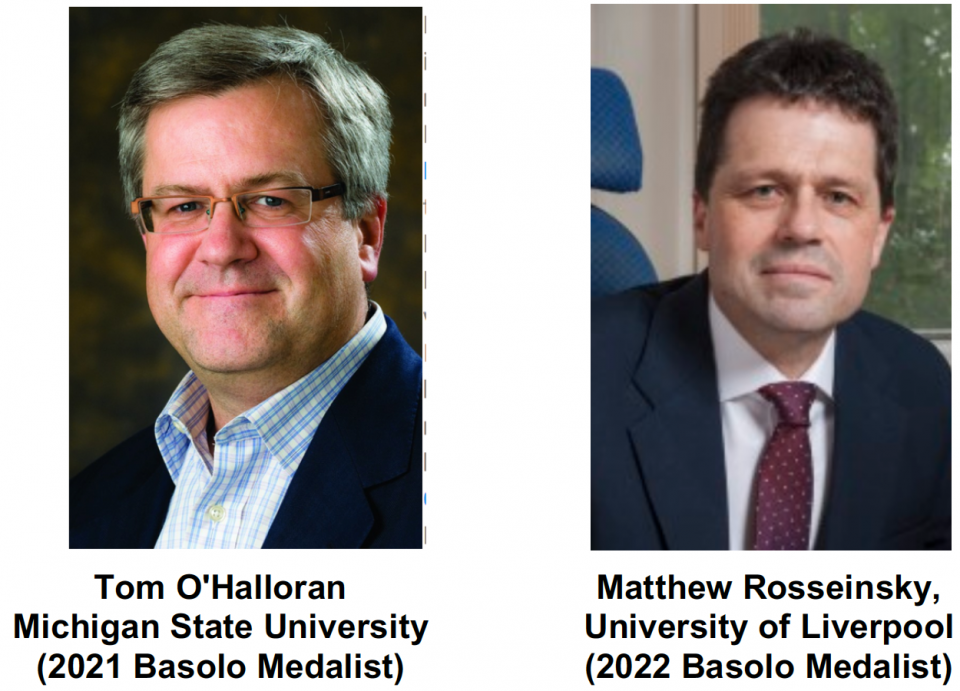
Tom O'Halloran, Michigan State University (2021 Basolo Medalist)
"Inorganic Chemistry in Control of Biological Processes: From Werner Chemistry to the Greasy Kid Stuff"
Matthew Rosseinsky, University of Liverpool (2022 Basolo Medalist)
“Discovery Synthesis of Inorganic Functional Materials in the Digital Age”
Remember, the technical talks are at Northwestern University, starting at 3:30, and the dinner is at the Hilton Garden Inn, starting at 6:30.
ABSTRACTS
Inorganic Chemistry in Control of Biological Processes: From Werner Chemistry to the Greasy Kid Stuff
Thomas V. O’Halloran, Ph.D.
Michigan State University
Transition metals are accrued to high levels by all cells and 30% of genes in most genomes encode metal-dependent proteins. Management of the cellular metallome involves specific transporter as well as metallochaperone and metalloregulatory proteins that conduct metal cofactors to appropriate intracellular targets or sense metals and regulate discrete processes like transcription, translation and cell division. Metal occupancy in these factors mediates a diverse array of cellular decisions including cell cycle control and differentiation in eukaryotes and activation of pathogenicity in prokaryotes. Recent structural and biophysical studies reveal molecular mechanisms for transducing these signals and the extreme thermodynamic sensitivity of these metal-responsive molecular switches. While steady-state concentrations of free copper and zinc ions are generally quite low in the cytosol, transient increases are seen in signaling events and in specialized compartments. Unexpectedly, we have found that stepwise fluctuations in zinc concentration are also required for maturation and function of germ cells across the tree of life. The best understood of these mechanisms are found in mammalian egg and sperm cells at the time of fertilization and in the earliest steps of embryo development. Single-cell x-ray fluorescence microscopy, LA-ICP-TOF-MS, and STEM-EDS studies reveal that billions of zinc atoms per cell undergo translocation, including events known as ‘zinc sparks’, before the embryonic development can proceed. We find that zinc, and now manganese, are released from thousands of compartments which contain, on average, millions of metal ions (Nature Chemistry, 2015 and 2021). These newly discovered inorganic fluxes, metalloregulatory receptors and metal trafficking mechanisms constitute an emerging level of information transfer in biological signaling networks. Studies of this kind are revealing targets for development of new diagnostic and therapeutic interventions in health and disease.
Discovery Synthesis of Inorganic Functional Materials in the Digital Age
M.J. Rosseinsky, Ph.D.
Department of Chemistry, University of Liverpool, Liverpool L69 7ZD, UK
The need for new materials to tackle societal challenges in energy and sustainability is widely acknowledged. As demands for performance increase while resource constraints narrow available options, the vastness of composition, structure and process parameter space makes the apparently simple questions of where to look for and how to then find the materials we need a grand challenge to contemporary physical science. This talk will emphasize that discovery synthesis of new inorganic materials is at the extreme forefront of this endeavor. Using the functional properties of thermal conductivity (Science 373, 1017, 2021) and solid state transport of lithium ions (Nature Communications 12, 5561, 2021; J. Am. Chem. Soc. 143, 18216, 2021), I will illustrate how expanding our understanding of how to arrange atoms for function leads to outperformance.
The talk focuses on the experimental synthesis of new materials (i.e., materials without structural precedent in the databases). It will illustrate with recent examples how decision support for the expert synthesis researcher can increasingly be provided with digital tools, based on physical models (Nature 546, 280, 2017) and also on machine learning from well-curated experimental data (Angewandte Chemie-International Edition. 60, 2, 2021). The aim is to engage those interested in inorganic chemistry, materials chemistry, condensed matter physics, materials science and generally in digital routes to predict and understand materials.
PROGRAM LOCATION AND SCHEDULE
Northwestern University Technological Institute, 2145 Sheridan Road, Evanston, IL 60208
- Tech K140 12:00 p.m. Special BIP Seminar
- Tech LR3 3:15 p.m. - 3:30 p.m. Refreshments
- Tech LR3 3:30 p.m. - 6:00 p.m. Award Presentations/Lectures
- 3:30 p.m. Tom O'Halloran
- 5:00 p.m. Matthew Rosseinsky
DINNER LOCATION AND CHOICES
Hilton Garden Inn - 1818 Maple Avenue, Evanston, IL 60201
About a mile from the Technological Institute
- 6: 30 p.m. Reception
- 7:30 p.m. Medal Presentation and Dinner
- 8:30 p.m. General ACS Meeting
DINNER MENU:
Entrees: (choice of 1):
• New York Strip Steak (beef)
• Salmon Wellington (fish)
• Quinoa Stuffed Peppers with mushroom and zucchini in marinara sauce (vegetarian/gluten free)
• Caesar Salad
• Chef's choice of vegetable and starch
• Dessert: chocolate lava cake
• Coffee, decaffeinated coffee, and tea
QUESTIONS?
QUESTIONS? Please contact the Section Office via phone (847-391-9091) or email ([email protected]).
BIOGRAPHIES
Thomas O'Halloran
Thomas O’Halloran, Ph.D., is Foundation Professor in the Department of Microbiology & Molecular Genetics and the Department of Chemistry at Michigan State University. Dr. O’Halloran’s research focuses on new inorganic compounds that could lead to a treatment for certain types of blood, breast, and brain cancers.
O’Halloran earned his Ph.D. in Bioinorganic Chemistry from Columbia University and he also holds a M.A. in Chemistry from the University of Missouri. He completed his postdoctoral training at Massachusetts Institute of Technology. Prior to joining MSU, Dr. O’Halloran was a faculty member at Northwestern University.
Dr. O’Halloran’s research program focuses on the discovery of soluble metal receptor proteins, the pathways they participate in, and the mechanisms by which they regulate cellular events and the physiology of the organism. This group adopts an interdisciplinary approach to elucidate chemical mechanisms, protein structures, biochemistry, regulatory metal ion fluxes and physiology of metal receptors. Dr. O’Halloran’s work has defined a new family of metal receptors that regulate gene expression in response to changes in metal ion concentration the metalloregulatory proteins. He is also known for his work establishing another class of metal-receptors known as metallochaperone proteins, which govern metal flow through the cell. More recently he is focusing on the inorganic phenotypes of metastatic breast cancer: this work reveals how cells differentially control iron, copper and zinc quotas in normal and tumorigenic cells. Related studies led to the discovery of anticancer agents, including platinum-family drugs, that target emerging metal-regulated pathways.
Matthew Rosseinsky
Matthew Rosseinsky study chemistry at University of Oxford, receiving a B.A. in 1987 and a D. Phil. in 1990. He moved to AT&T Bell Laboratories, Murray Hill, New Jersey where he was a Postdoctoral Member of Technical Staff. In 1992, he returned to Oxford as a Lecturer in Inorganic Chemistry and Student (Fellow) of Christ Church. In 1999, he moved to the University of Liverpool as Professor of Inorganic Chemistry.
Rosseinsky has been awarded the Harrison Memorial Prize (1991), Corday-Morgan Medal and Prize (2000) and Tilden Lectureship (2006) of the Royal Society of Chemistry (RSC). In 2009, he received the inaugural De Gennes Prize from the RSC — a lifetime achievement award in materials chemistry that is open internationally and is one of the RSC’s three premier awards. He was Distinguished Lecturer in Inorganic Chemistry, Northwestern University (2006), Zernike Lecturer, Rijksuniversiteit Groningen (2009) and won the C.N.R. Rao Award of the Chemical Research Society of India in 2010. In 2017, he was Muetterties Lecturer at the University of California, Berkeley and the Lee Memorial Lecturer at the University of Chicago.
He was elected to the Royal Society in 2008, and was awarded the Hughes Medal of the Royal Society in 2011 "for his influential discoveries in the synthetic chemistry of solid state electronic materials and novel microporous structures." In 2017, he was awarded the Davy Medal of the Royal Society “for his advances in the design and discovery of functional materials, integrating the development of new experimental and computational techniques.” He is currently a Royal Society Research Professor (since 2013).
Professor Rosseinsky works on the synthetic chemistry, design and discovery of solid state materials, which have applications ranging from catalysis to superconductivity. A current focus is the development of new methods of identifying functional materials, emphasizing the integration of experiment with computational methods.
Registration closes at 6 PM Thursday, October 6!
Tickets
$48.00 REGISTRATION: Chicago ACS member
$48.00 REGISTRATION: Guest and Non-Chicago ACS member


